
Explainable AI
AI decisions you can explain and audit.
Clean data is necessary. It is not enough. The system still has to explain itself, because in finance, insurance, and life sciences, a decision you cannot explain is a decision you cannot ship. We build explainability into the models and agents in scope, in three layers, so every output arrives with the evidence your reviewers need.

The Problem
A model that cannot be explained should not make decisions that matter.
Credit, claims, and compliance review all need a reason behind every outcome. Black-box models give an answer without one, so projects stall before they reach production.
Audit exposure
Regulators and model-risk teams ask for the evidence behind each decision. Without it, you have an answer and no record.
Stalled approvals
Risk, legal, and compliance reviewers will not sign off on what they cannot inspect, so pilots sit in review.
Blind debugging
When accuracy drops or bias appears, teams often cannot tell which inputs drove the change.
Lost trust
Underwriters and analysts override outputs they do not understand, and the value of automation is lost.
Our Approach
Explainability engineered into three layers, not added at the end.
It works across classical ML, deep learning, and LLM agents, whether we built the model or you run it today. Where a model is too opaque to explain well, we say so.
The work behind it is checkable: our SOA research on explainable AI for regulated actuarial work, the eval harness we built, and the explanation sample schema we test every explanation against.
Before training
Data
Know where every input came from.
- Lineage from source system to model feature
- Quality and bias checks before training
- Documented datasets with owners and permitted use
Inside the model
Model
Know what drives every prediction.
- Global drivers: which features matter overall
- Local reasons: why this case got this outcome
- Counterfactuals: what would change the result
SHAP and LIME show which inputs mattered most, counterfactuals show what would change the outcome, and model cards record what a model is for and how it was tested.
At decision time
Decision
Keep a record of decisions in scope.
- A plain-language reason for each outcome
- A versioned, searchable log of inputs, model, explanation, and reviewer
- Low-confidence cases routed to human review with reasoning attached
What sits around explainability
Explainability is the core. Around it sit the parts that make AI safe to run. Guardrails: checks on what agents can do and what they can write. Data quality: the data underneath the model, clean and governed. Production readiness: the 8-area review that says whether a system is ready to run. Workbenches: the tools your team uses to inspect, test, and challenge what the AI does. AI training: your team learns to run it.
What You Get
Evidence your reviewers, customers, and regulators can use.
Each engagement ends with artifacts your teams keep using after handover.
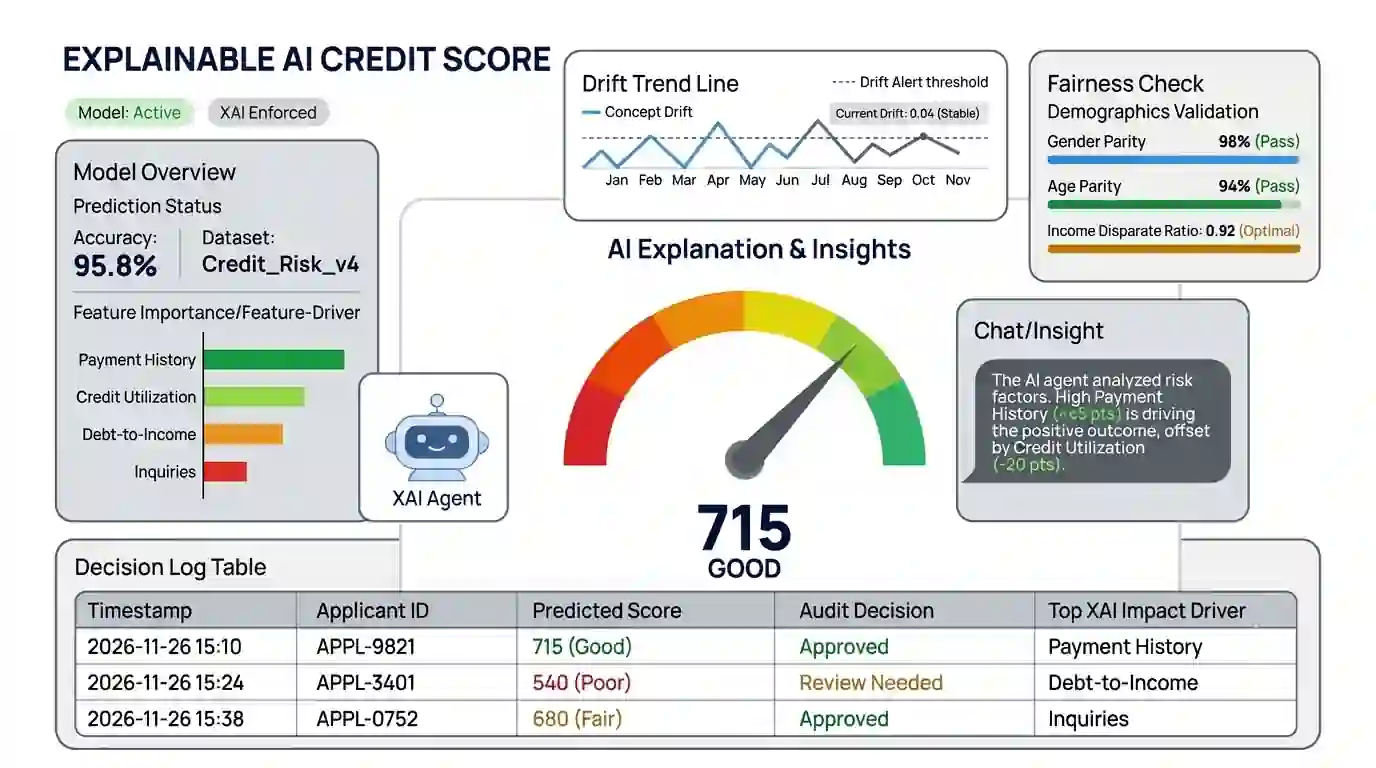
Decision explanations
Plain-language reasons and ranked factors for each outcome in scope, in the format your reviewers and customers need.
Model and data documentation
Model cards, lineage maps, and validation reports organized for model-risk review.
Explainability dashboard
A view of drivers, drift, fairness metrics, and explanation stability across the models in scope.
Governance controls
Approval thresholds, human review queues, and audit logs that support requirements such as NIST AI RMF, SR 11-7, and the EU AI Act. Mapping is not compliance. The final determination rests with your legal and compliance teams.
FAQ
Get Started
Ready to make your AI decisions explainable?
Book a technical consultation. We'll review a model or agent you run today and show you what an explanation record for it would look like.